

Walla Walla had a big windstorm earlier this week. Not the biggest, and nothing like the weather damage happening on the west side, but nonetheless. The casualties included one of my chickens — the neighbor’s fence blew over, the neighbor’s dog blew in, and… well, let’s just say it’s probably good that chickens don’t have very long memories.
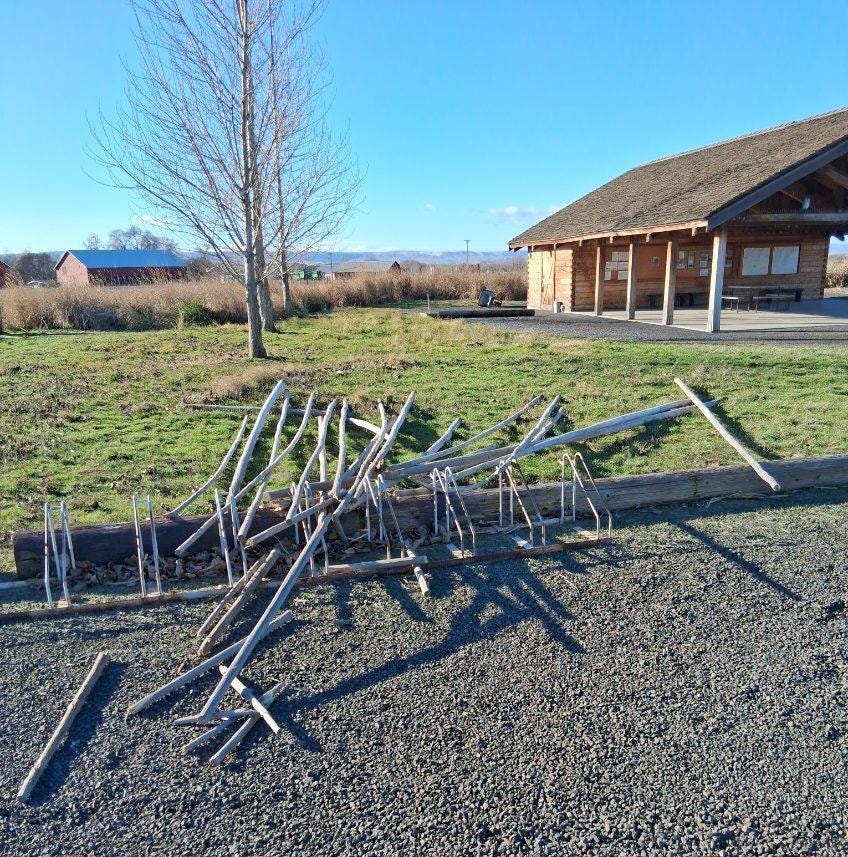
Frenchtown also had a casualty — the wind flattened our tepee structure, even in the absence of any covering. Absolutely shattered it, drop-kicked it into the parking lot.
We put up the tepee for Saint Jean Baptiste Day in 2019. Board members Charles, Richard, and Ross (I think; my memory is spotty there) went up in the hills and brought back a trailer of lodge pole pine (note the name). We stripped most of the poles in advance, and saved a few for a demonstration and activity on the day of the event.


Going through the pictures is a happy-sad moment — featured are board members Ross Osborn (1943-2023) in green, and Elaine MacDonald (1946-2025) in black. There’s some Gagnon descendants as well, and some kids who will be graduating from high school here shortly.
The board’s first reaction to seeing the photo of the matchsticks that are all that remain of our poor tepee structure was dismay and maybe a bit of discouragement. How are we going to replace it, now what, that sort of thing. Looking through the photos of its life at the site, I feel a little differently now.
We use a photo of the tepee frame with the cabin in the background for many of our publicity materials, including this newsletter. They are recognizable structures, specific to the site and more generally to the topic of the early Frenchtown community. They illustrate two very different housing technologies, each with its own strengths and purpose. The cabin is altogether more permanent, which is both its advantage and its disadvantage. The effort and materials cost of its creation or replacement is significant and slow. It is entirely inflexible in its location (well, unless you get a grant). The tepee, on the other hand, is both moveable and renewable, expandable, storable, and adaptable to the materials at hand (coverings in hide or reeds, different woods, etc.). Frenchtown was a combination of the two, coexisting, not replacing.
So I think this coming year we need to build a new tepee structure, and celebrate renewal, and adaptability, and let some kids learn how to skin the poles.
How can you help, you say?
(I know, you said it under your breath, but I swear I heard you.)
Volunteer!
There are all different kinds of skills and tasks and needs associated with Frenchtown, from cutting lodge pole pine to pulling weeds to talking to kids to writing grants — or newsletters.
Join the board!
We are a small and friendly board with a shared passion for the history of Frenchtown and its importance for understanding our region. At the moment, we are especially looking for people with financial or legal expertise.
Donate to the Valley Giving Guide to support our mission.
We are an entirely volunteer organization, and all funds go to the maintenance and interpretation of the Frenchtown Historic Site and story. Expenses range from paying the power bill and pumping the potty (er, the vault toilet) to insurance, goats for weed control, new plants for the restoration project, website and printing, hosting events for the public, and more. We’re open to the public 7 days a week 365 days a year, and thanks to our work and your support, these stories reach people from around the region and the world.
Questions or comments? Email us at frenchtownhistoricfoundation@gmail.com.
©Sarah Hurlburt on behalf of the Frenchtown Historical Foundation.