
Context is everything
On passing

There’s an article in the New York Times today by Susan Saulny about a pair of brothers in Louisiana. “A Family Secret No More” (gift article) tells the story of her grandfather George DeGrange, a black man in Louisiana, and his full brother Ned – a white-passing man in Chicago. Susan’s story takes us through her research and eventual reunion with a branch of the family kept secret from the children, on both sides, because of American race politics. There’s a lot going on in this wonderful article, and if you’ve got a spare moment (probably more like 20 spare moments, it’s a long piece), I recommend it.
It got me thinking once again about some pieces of history closer to home. The immediate descendants of Frenchtown, whether of the Frenchtown outside of Walla Walla or pf the Frenchtowns of the Pacific Northwest fort system more generally (this would include Colville, French Prairie, Cowlitz Prairie, and so on) demonstrate the strict limits and limitations of American census race categories, and the complexity of contexts. Sometimes white, sometimes Indian, individual children of the fur trade moved back and forth between the two categories in census documents across sometimes their entire lives, depending on the context in which they live.
I cannot write a story as rich as Susan Saulny’s journey — there’s no one alive to report back about what it was like to “pass”, or not pass, as a white person in 1870, 1880, 1900. But each time I find a conflicting document, the question resurfaces–what determined the answer to that question, the question about what race you are, and who gave it? To what degree was race a choice for these individuals, as opposed to an externally imposed classification?
I’m sure that if I had a spare week to spend on the question I could come up with an example closer in structure to that of the DeGrange brothers, full siblings who took different paths to assimilation, one to the Reservation and one to white, but what I have to offer you is my Sunday morning, and so I’m going to work with the example of two families from the 1870 Frenchtown census, the McBeans and the Gagnons.
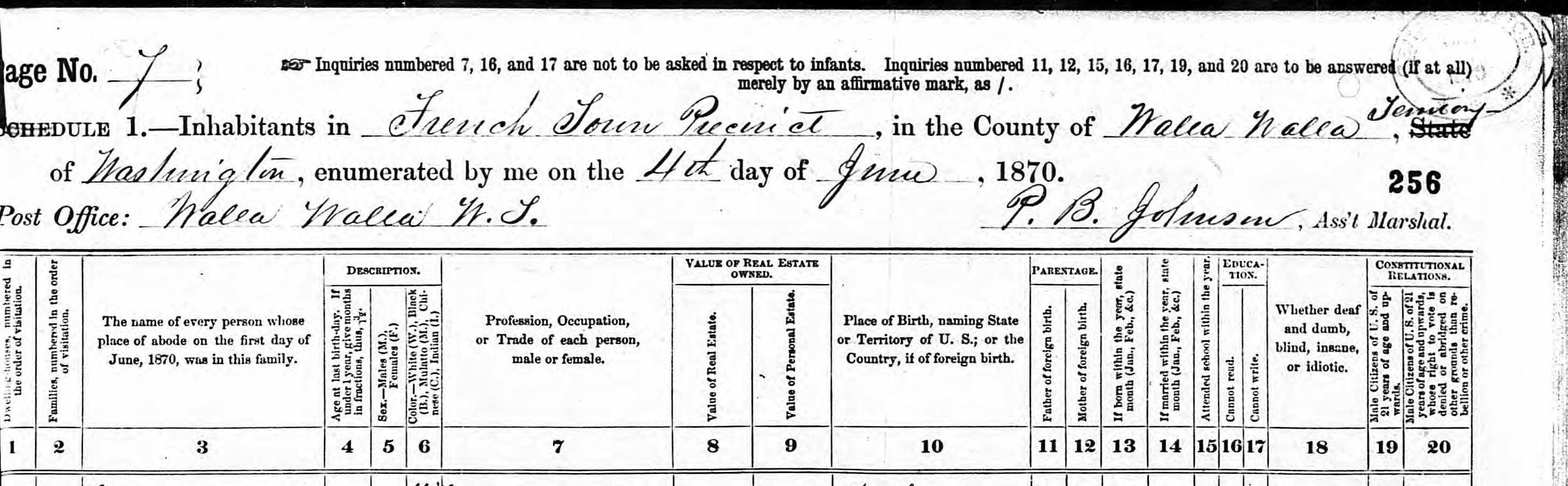
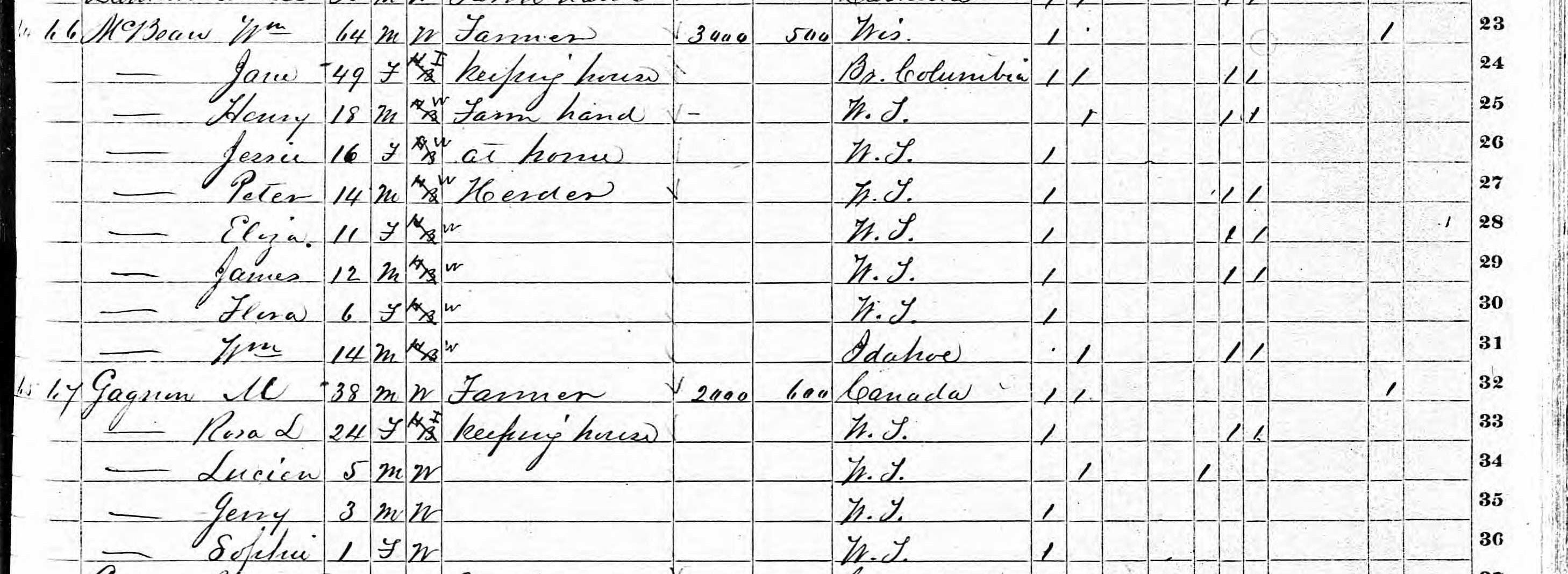
Let’s start with Jane Boucher McBean (line 2 of the image above). She was born in November 1820 in Stuart Lake, British Columbia, Canada. She was ¼ Cree and ¼ Sekani; both of her grandfathers were fur traders who married native women.
I spent odd moments chewing on this census document for years. In this census, Jane’s race was initially marked “HB,” then crossed out and replaced with “I,” or “Indian.” The race of her children, also initially labeled “HB,” is crossed out and marked “W” or “white.”The first question, why is “HB” crossed out, seems fairly obvious–there were only five official categories for the race column for the 1870 census, and somebody went through and “corrected” those answers, picking one of the official categories. How then is it that Jane’s “HB” is marked “Indian”, and that of her children is changed to “W”?
It seems clear at the very least that the 1870 census taker wrote “HB” because the people he was ennumerating didn’t fit neatly into the available categories. Comparison with other entries from the same document suggest that the corrections were based entirely on the stated race of the head of the household. This means that the children of a widow marked either “I” or “HB” would revert to “I”; the children of a man marked “W” would revert to “W”, regardless of the race of his wife.
After the 1870 census, this sort of creative license in the race column never resurfaces. Instead, the race designation for the mixed-race children of these two couples moves around according to where they are living. Let’s make a little chart to compare. Today’s examples are Mary Ann McBean and Lucien Gagnon. I’m cheating a little bit, because Mary Ann McBean is in fact the daughter of William McBean and Jane Boucher, the couple in the example above, but in 1870 she was already married to a white man, Edward LaFave. Lucien appears as a son in the document above.
[Cue three hours of my Sunday morning, which I will never see again.]
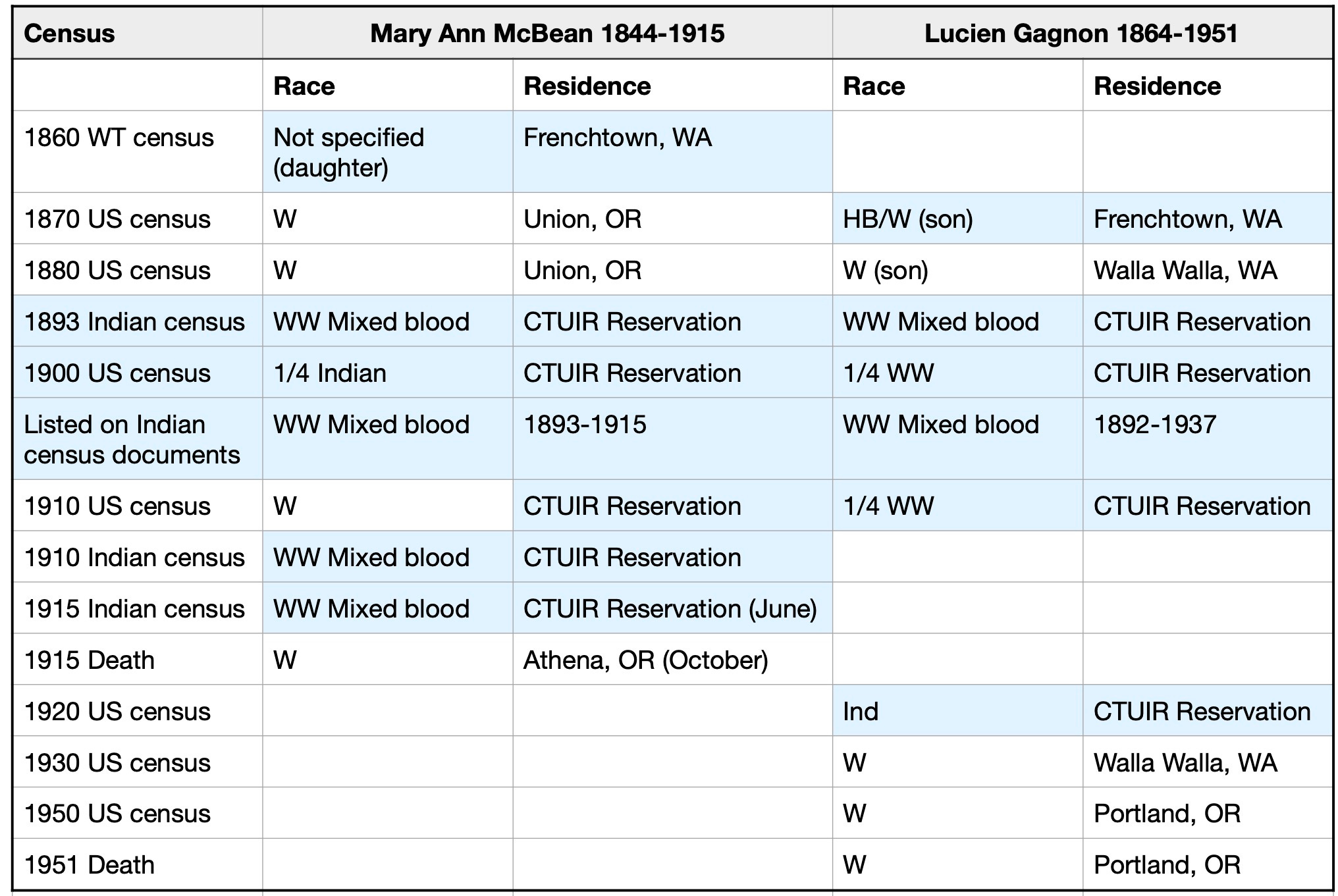
In short, in almost every case, after 1870 the official racial designation for these individuals changes according to their place of residence, whether they are living (or dying) in a white community or on the Reservation.
This isn’t just an abstract investigation. The question of the status of mixed race persons in the land allotment period, and the subsequent fractionalization of the reservation, is still a fraught topic in 2026 precisely because of the land. But here’s a question I can’t answer, but that I think is worth asking — were these individuals “fake Indians”… or were they “passing” as white? Either, neither … or both?
© Sarah Hurlburt 2026
The race status in census records were not determined by the individuals but the instructions given to the emulators. There is a very good explanation of race status in census records on the Native Heritage Project site. It defines census instructions from 1790 to 2010. Other circumstances were involved not just the percentage of blood or appearance but social and economical factors as well.
Jane McBean was the sister of Sophia Crate married to Edward Crate. Edward and Sophia were one of the first land owners in The Dalles around 1855. Following their census records , the same factor of being listed as white occurs. Their children blended into society as citizens and were listed as white also.
https://nativeheritageproject.com/2013/05/14/indians-and-the-census-1790-2010/
Fascinating, thank you Sarah.